

Four adults of mixed ages training in a bright warehouse gym at sunrise, one racking a barbell while another chalks her hands

Four twelve-week blocks

Programmes

Four programmes, each written as a twelve-week block with a measured start and a measured finish. Run one, or stack a main programme with Range & Recovery and Everyday Fuel. Everything scales to the equipment you actually have.

4

Core programmes, all four included on every plan

12 weeks

Block length, with a deload and a retest week scheduled in

82%

Of members finish their first twelve-week block

12 weeks

The length of every block, start to measured finish

The four programmes

Written by a coach, not generated from a template

Every session lists the intent, not just the reps. Each block opens with an assessment and closes with a retest, so what changed is measured rather than felt.

A woman setting up for a barbell back squat in a home garage gym, hands wide on the bar and roller door open behind her

Foundation Strength

12 weeks3 sessions a week50–70 min

Add measurable load to your squat, hinge, push and pull — most members put 15–30% on their main lifts across one twelve-week block.

Who it is for

People who want to get genuinely stronger and have access to a barbell or a solid set of dumbbells. Ideal if you have trained before, or you have been going to the gym for a while without a plan and your numbers have stopped moving.

What a week looks like

Three sessions a week, 50–70 minutes each, run as three waves of four weeks. Wave one builds position and tolerance, wave two adds load, wave three tests. Week 12 is a retest week — you finish with real numbers, not a feeling.

Equipment you need

Barbell, plates and a rack, or an adjustable dumbbell set. Bench and pull-up bar useful but not essential — every lift has a listed swap.

Level

Beginner to intermediate. No lifting experience required; every main lift has a video walkthrough and a scaled entry version.

What you get

  • Four main lifts tracked week to week with prescribed loads and RPE
  • Video technique walkthrough for every movement
  • Warm-up and accessory work built into each session
  • A deload week and a retest week, scheduled — not improvised
  • Written swap options for missing equipment or a cranky shoulder

A man in his forties running an easy pace along a coastal path in early morning light

Engine Build

12 weeks4 sessions a week30–45 min

Better cardio you can feel in ordinary life — stairs, hills, chasing kids, the back half of a game. Most members drop their 2km time trial by 60–90 seconds over a block.

Who it is for

Anyone whose fitness has slipped and wants it back without hating every session. Also good for lifters who are strong but blow up after three minutes of work.

What a week looks like

Four sessions a week, 30–45 minutes each — roughly 80% easy aerobic work and 20% hard intervals. Yes, it is meant to feel too easy in week one. That is the point: the easy work is what makes the hard work possible.

Equipment you need

A pair of shoes and somewhere to run, walk or ride. Rower, bike or treadmill all work. Every session lists an indoor and an outdoor version.

Level

All levels. Your entry point is set by a week-one time trial, so the programme scales to you rather than the other way around.

What you get

  • Week-one and week-twelve time trials to measure the change
  • Heart-rate and effort zones explained in plain language
  • Interval sessions with exact work-to-rest prescriptions
  • Indoor and outdoor version of every session
  • Guidance on what to do when you are tired, sore or short on time
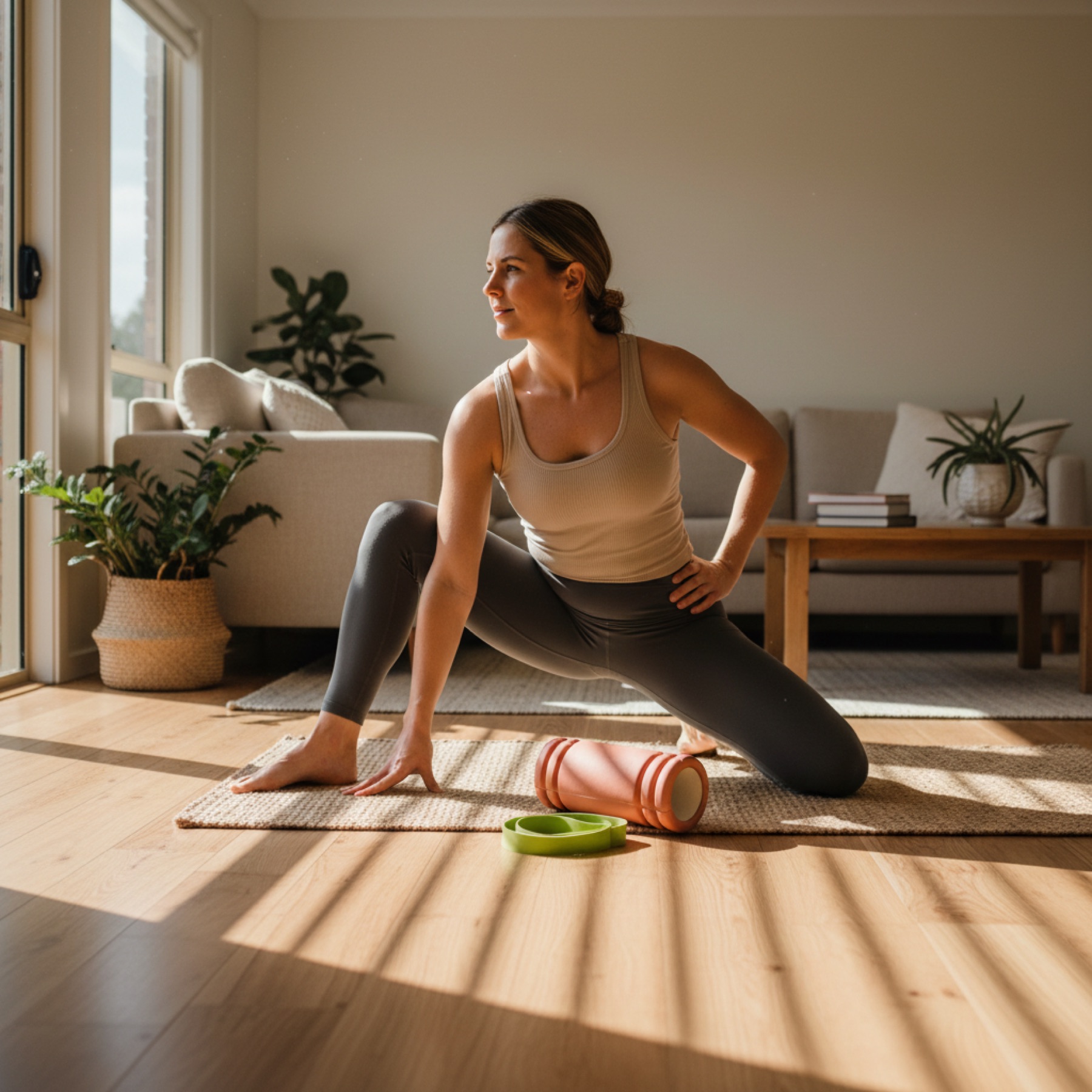
A person on a mat in a sunlit living room holding a deep supported hip stretch, with a foam roller and resistance band beside them

Range & Recovery

12 weeks5 sessions a week12–20 min

Move through fuller range with less stiffness — overhead position, deeper squat, hips and mid-back that do not complain after a day at a desk.

Who it is for

Desk workers, people who feel tight rather than weak, and anyone running a strength or conditioning block who wants their body to hold up across all twelve weeks.

What a week looks like

Five short sessions a week, 12–20 minutes each: three daily resets midweek and two longer flows on the weekend. Designed to sit alongside another programme rather than replace it.

Equipment you need

Floor space and a mat. A resistance band and a foam roller are used in about a third of the sessions; alternatives are listed for both.

Level

All levels, including complete beginners. Nothing in it requires existing flexibility.

What you get

  • A four-point range assessment you repeat at weeks 1, 6 and 12
  • Daily 12-minute resets for hips, mid-back, shoulders and ankles
  • Two longer weekend flows for loaded range and control
  • Follow-along video for every session — no reading mid-flow
  • Pre-training and post-training routines you can bolt onto any other programme
An overhead view of a kitchen bench with a half-unpacked supermarket shop: chicken, eggs, rice, broccoli, capsicum, tinned legumes and yoghurt

Everyday Fuel

12 weeksOne habit a fortnight15 min planning a week

A way of eating you can keep doing after the twelve weeks finish — enough protein, enough food to train on, and a shop that does not cost a fortune.

Who it is for

People who train reasonably well and eat somewhat at random. Anyone who has tried a restrictive plan, done well for six weeks, then gone back to exactly where they started.

What a week looks like

One change introduced each fortnight, then held — six changes across the block, and about 15 minutes of planning a week. No calorie counting required, though there is a tracked track if you prefer numbers.

Equipment you need

A kitchen and a supermarket. That is it. No supplements are required, sold or recommended as necessary.

Level

All levels. Vegetarian, halal, gluten-free and dairy-free versions of every meal framework are included.

What you get

  • A fortnightly habit sequence — protein, vegetables, timing, alcohol, sleep, planning
  • Australian supermarket shopping lists with realistic weekly costs
  • 40 meal frameworks, not rigid recipes, so you can use what is in the fridge
  • Portion guidance by hand size — no scales unless you want them
  • A tracked track with macro targets for members who prefer counting
  • Eating-out and weekend guidance that assumes you have a social life

Everyday Fuel is general nutrition guidance for healthy adults. It is not individual dietary advice. If you are pregnant, managing a medical condition or working with a dietitian, check with them before you start.

Side by side

Which one fits your week

Same block length, same measured start and finish. What changes is the focus, the time it asks for and the gear you need.

All four programmes run as twelve-week blocks and are included on every plan.
ProgrammeFocusSessions a weekEquipmentLevel
Foundation StrengthMaximal and repeatable strength — squat, hinge, push and pull3 a week · 50–70 minBarbell, plates and a rack, or adjustable dumbbellsBeginner to intermediate
Engine BuildAerobic base and interval capacity, measured by time trial4 a week · 30–45 minShoes and somewhere to move, or a rower, bike or treadmillAll levels
Range & RecoveryUsable range and control — hips, mid-back, shoulders, ankles5 a week · 12–20 minMat and floor space; band and roller optionalAll levels, including complete beginners
Everyday FuelEating enough to train on, built one habit at a timeOngoing · one habit a fortnightA kitchen and a supermarketAll levels

Stacking

Run one, or stack two

Range & Recovery and Everyday Fuel are built to sit alongside a main programme. The mobility work is 12 to 20 minutes a day and the nutrition work is one change a fortnight, so neither competes with your training time.

Running Foundation Strength and Engine Build together works too, but only if you can commit to five or six sessions a week. If you cannot, pick one, finish the block, then switch — a half-finished block tells you nothing at retest.

Blocks are designed to stack. Your coach sets the order and adjusts the load when two are running at once, so the combined week still adds up to something you can actually recover from.

A woman in her fifties catching her breath after a set of kettlebell swings in a suburban garage gym

Questions

Before you start

The six things members ask us most about the programmes. Anything else, send it through and a coach will answer within one business day.

Do I need a gym membership?

No. Foundation Strength needs a barbell or a decent set of dumbbells, which plenty of members have in a garage. Engine Build needs shoes. Range & Recovery needs floor space. Everyday Fuel needs a kitchen.

Every session lists equipment swaps, so a hotel gym or a park will not derail your week.

Can I run two programmes at once?

Yes, and most members do. Range & Recovery and Everyday Fuel are built to run alongside a main programme.

Running Foundation Strength and Engine Build together works too, but only if you can commit to five or six sessions a week — otherwise pick one, finish the block, then switch.

What if I have never lifted before?

Then start with Foundation Strength anyway. Week one is deliberately light and exists to teach positions, not to test you.

Every main lift has a video walkthrough and a scaled entry version, and you can send your coach a video of your own set and get notes back.

How long until I see a change?

Strength numbers usually move first — often within three or four weeks. Conditioning takes six to eight weeks before it is obvious. Body composition changes are slower and depend more on Everyday Fuel than on training.

Twelve weeks is our block length because that is roughly how long a real change takes to show up in the data.

What happens after twelve weeks?

You retest, then you start the next block. Every programme finishes with a measurement week and a written plan for what comes next.

Your coach writes the next block around your retest numbers rather than starting you over from scratch.

I have got a niggling injury. Can I still start?

Talk to your GP or physio first — we are a fitness programme, not a health service, and we will not work around an injury we have not been cleared to work around.

Once you have been cleared, tell your coach what you have been advised and they will adjust the programme. Every block also lists movement swaps you can use yourself.

An empty gym floor at dawn with a loaded barbell, two kettlebells and a rolled mat set out ready

Start a block

Start this week, not next quarter.

Tell us your training history, the equipment you have and the time you actually get. We’ll come back with the block we’d put you on and the reasoning behind it.